HVACFull System Replacement
Heat Pump Replacement & Installation Cost in 2026: Prices by Home Size & SEER2
Heat pump replacement typically costs $5,000 to $15,000, with a U.S. national average of $8,350.
Cost snapshot
U.S. national figures ·
- Typical range
- $5,000 – $15,000
- National average
- $8,350
- Full range
- $4,000 – $25,000
Where the typical range comes from: Fixr's published average range for an installed air-source heat pump; the outer ends are Fixr's $4,000 low for air-source units and its $25,000 top for 3,000 sq ft homes and 20+ SEER2 systems.
Replacing an air-source heat pump typically costs $5,000 to $15,000 installed, about $8,350 on average (Fixr). This Old House reports a similar $8,042 average for a central heat pump and $8,007 for a whole-home air-source replacement, and about $12,000 for a 2,000 sq ft home. Size and efficiency move the price most: Fixr lists $5,000 to $8,000 for a 1,000 sq ft home and $15,000 to $25,000 for 3,000 sq ft, and $5,000 to $12,000 at 14 to 15 SEER2 against $15,000 to $25,000 at 20+ SEER2. A ductless mini split costs $2,000 to $8,000 and geothermal $15,000 to $35,000.
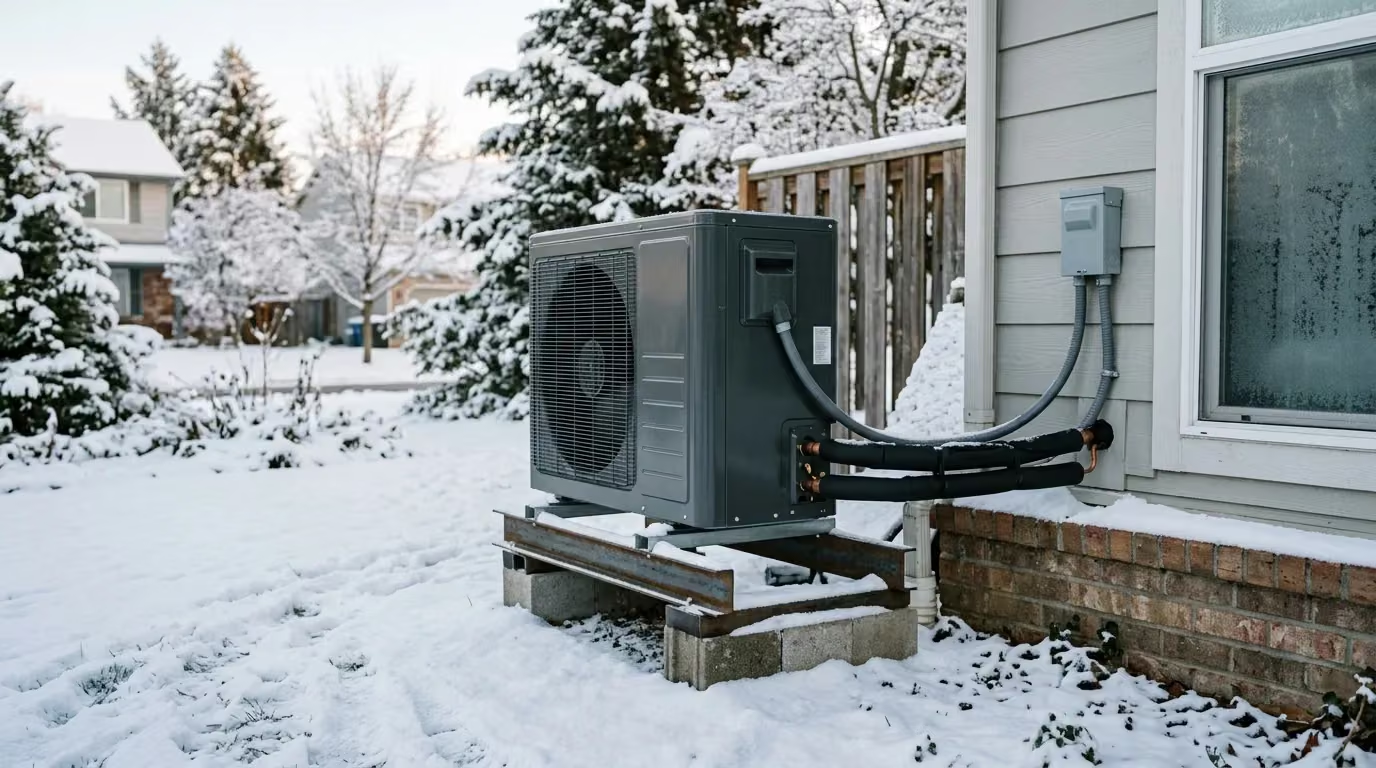
Overview
Heat Pump Replacement Cost: Overview
Heat pump replacement costs $5,000 to $15,000 installed, about $8,350 on average (Fixr). Compare prices by home size, SEER2, refrigerant and repair vs replace.
These figures come from the published cost sources listed under Methodology & sources; figures we calculate are labeled. Setting a ZIP code or state adjusts only the labor share, using Bureau of Labor Statistics wage data.
| What it covers | Typical range | Basis |
|---|---|---|
| Installed project | $5,000 – $15,000National average: $8,350 | Medium confidence; cited: Fixr, This Old House |
| Equipment or materials | $4,200 – $7,600 | Cited: This Old House |
| Labor | $2,200 – $4,800 | Cited: Fixr, This Old House |
By size
Cost by Capacity & Scope
HVAC costs scale with system capacity (tonnage or motor size), the size of the home being served, and the scope of the work.
| Size or scope | Typical home coverage | Installed cost | Average | Source |
|---|---|---|---|---|
| 1,000 sq ft home (2 tons) | Fixr installed price; average shown is the midpoint | $5,000 – $8,000 | $6,500 | Fixr |
| 1,500 sq ft home (2.5 to 3 tons) | Fixr installed price; midpoint | $6,700 – $14,000 | $10,350 | Fixr |
| 2,000 sq ft home (3 to 4 tons) | Fixr installed price; midpoint (This Old House: about $12,000 on average) | $8,000 – $20,000 | $14,000 | Fixr, This Old House |
| 2,500 sq ft home (3.5 to 5 tons) | Fixr installed price; midpoint | $9,500 – $22,000 | $15,750 | Fixr |
| 3,000 sq ft home (4 to 6 tons) | Fixr installed price; midpoint | $15,000 – $25,000 | $20,000 | Fixr |
By type
Cost by Equipment Type & Efficiency
| Type | What it involves | Typical cost |
|---|---|---|
| Standard Efficiency (14–15 SEER2)Installed (Fixr) | Entry-level air-source heat pump. | $5,000 – $12,000Fixr |
| Mid Efficiency (16–17 SEER2)Installed (Fixr) | Often two-stage; better comfort in mild weather. | $7,000 – $15,000Fixr |
| High Efficiency (18–19 SEER2)Installed (Fixr) | Variable-speed (inverter) equipment. | $10,000 – $18,000Fixr |
| Premium (20+ SEER2)Installed (Fixr) | Top-efficiency variable-speed systems. | $15,000 – $25,000Fixr |
| Cold-Climate Heat PumpENERGY STAR cold climate | Models built to keep heating at low outdoor temperatures (ENERGY STAR has a cold-climate designation). Our sources do not price them separately; This Old House says cold-climate models with enhanced compressors and higher heating capacity typically cost more than standard models. | Not published separatelyThis Old House |
| Ductless Mini-Split Heat PumpInstalled (Fixr) | No ducts needed; priced by zone. See the mini split guide. | $2,000 – $8,000Fixr |
| Geothermal Heat PumpInstalled (Fixr) | Ground-source loop; much higher upfront cost. | $15,000 – $35,000 (Fixr) · about $17,000 small to medium home (TOH)This Old House |
Breakdown
Parts vs. Labor Breakdown
What the equipment or materials cost compared with the installer's labor, and what each figure is based on.
HVAC Mechanics and Installers
- Labor range
- $2,200 – $4,800
- Planning estimate of on-site hours
- 22 – 32 hrs
- BLS median employee wage
- $29.33/hr
- Equipment or materials: $4,200 – $7,600
- Heat pump equipment (outdoor unit and matching indoor air handler or coil). This Old House lists heat pump equipment at $4,200 to $7,600 excluding ductwork, and average equipment cost by brand from $4,550 (Ruud) to $9,550 (Trane).
- Labor: $2,200 – $4,800
- Installation crew. Fixr lists heat pump installers at $75 to $125 per hour and includes removal of the old unit in labor, while 58% of This Old House's surveyed owners who replaced a heat pump paid $150 or more per hour. The $2,200 to $4,800 range and the 22 to 32 crew hours are our planning assumption; no source publishes them. Benchmark: BLS reports a May 2025 national median wage of $29.33 per hour for HVAC mechanics and installers.
BLS reports what employees earn, not what contractors bill; contractor rates also cover insurance, vehicles, overhead and profit. We use the BLS wage only to adjust the labor share for your location.
Extras
Additional Line Items Often Needed
| Item | Typical added cost | Needed? | Notes |
|---|---|---|---|
| Ductwork Repair or Modification | $200 – $1,000Fixr | As Needed | Fixr ductwork repair range; full new ductwork runs $1,400 to $6,000 (Fixr furnace guide). |
| Smart or Wi-Fi Thermostat | $185 – $600Fixr | Recommended | Fixr thermostat guide; a basic replacement is $85 to $300. |
| Electrical Service Upgrade | Not published separatelyFixr | As Needed | Switching from gas heat can require a new 240-volt circuit or panel work; our heat pump sources do not price it, so get it itemized. |
| Permits | $50 – $300Fixr | Required | Fixr. |
Calculator
Heat Pump Replacement Cost Estimator
Choose the options closest to your project for a planning range. It is not a quote; compare it with written, itemized proposals.
1Home size
2Efficiency
A ZIP code scales the labor share of the estimate (about 30%) by the BLS wage ratio for the trade.
National planning estimate. Not a quote.
- Home size: Not sure (typical home)
- $5,000 – $15,000
- Efficiency
- Not sure
- Location
- National
A ZIP code or state changes only the labor share of the estimate, using the BLS Occupational Employment and Wage Statistics (May 2025) wage ratio for the trade. Materials, equipment and permits stay at national figures. Planning estimates, not contractor quotes.
The 'not sure' option is this guide's typical range from the cost snapshot.
Size options use Fixr's installed prices by home size from the table on this page.
With the size 'not sure', an efficiency option shows Fixr's installed range for that SEER2 tier. With a home size selected, the size row is multiplied by 1.1 (mid), 1.2 (high) or 1.5 (premium): MODELED ASSUMPTION, roughly the step between Fixr's tiers, not a published multiplier.
Results are capped at $25,000, the top of Fixr's published installed prices (its 20+ SEER2 tier).
Removal of the old unit is included in labor (Fixr). Ductwork and electrical upgrades are not included.
Location
Personalize This Estimate by ZIP or State
A ZIP code or state changes only the labor share of this guide's range (about 30%), using BLS wage data for the trade. Materials, equipment and permits stay at national figures. Results are estimates, not contractor quotes.
National figures: typical $5,000 – $15,000, average $8,350.
Leave empty for national figures.
$8,350
National average $8,350 · no location applied
- Typical range
- $5,000 – $15,000
- Full project range
- $4,000 – $25,000
- Labor index (BLS wage ratio)
- 1.00×
- Materials, equipment, permits
- National (not adjusted)
$2,200 – $4,800
National labor band. Hourly rate cited in this guide: $75–$125/hr (national).
$4,200 – $7,600
This guide's national allowance (see its sources); not adjusted by location.
Permits and inspections
This guide's permit allowance: $50 – $300. Fees and rules are set by each city or county; this is not a local fee lookup, so ask the contractor who pulls the permit and what it costs.
Typical range in all 50 states and DC
Modeled, not published by a source: the national typical range with the labor share (about 30%) scaled by each state's BLS Occupational Employment and Wage Statistics (May 2025) mean wage for heating, air conditioning, and refrigeration mechanics and installers, divided by the national mean of $31.14/hr. Materials, equipment and permits stay national.
| State | BLS mean wage | Labor index | Typical range | Average | Action |
|---|---|---|---|---|---|
| Alabama | $24.67/hr | 0.79× | $4,700 – $14,075 | $7,825 | |
| Alaska | $38.53/hr | 1.24× | $5,350 – $16,075 | $8,950 | |
| Arizona | $29.28/hr | 0.94× | $4,900 – $14,725 | $8,200 | |
| Arkansas | $24.59/hr | 0.79× | $4,675 – $14,050 | $7,825 | |
| California | $36.24/hr | 1.16× | $5,250 – $15,750 | $8,750 | |
| Colorado | $34.29/hr | 1.10× | $5,150 – $15,450 | $8,600 | |
| Connecticut | $35.38/hr | 1.14× | $5,200 – $15,600 | $8,700 | |
| Delaware | $31.80/hr | 1.02× | $5,025 – $15,100 | $8,400 | |
| District of Columbia | $40.83/hr | 1.31× | $5,475 – $16,400 | $9,125 | |
| Florida | $27.55/hr | 0.89× | $4,825 – $14,475 | $8,050 | |
| Georgia | $27.44/hr | 0.88× | $4,825 – $14,475 | $8,050 | |
| Hawaii | $32.24/hr | 1.03× | $5,050 – $15,150 | $8,450 | |
| Idaho | $28.85/hr | 0.93× | $4,900 – $14,675 | $8,175 | |
| Illinois | $37.29/hr | 1.20× | $5,300 – $15,875 | $8,850 | |
| Indiana | $31.30/hr | 1.00× | $5,000 – $15,025 | $8,375 | |
| Iowa | $30.35/hr | 0.97× | $4,975 – $14,900 | $8,275 | |
| Kansas | $29.55/hr | 0.95× | $4,925 – $14,775 | $8,225 | |
| Kentucky | $28.30/hr | 0.91× | $4,875 – $14,600 | $8,125 | |
| Louisiana | $27.35/hr | 0.88× | $4,825 – $14,450 | $8,050 | |
| Maine | $31.39/hr | 1.01× | $5,000 – $15,025 | $8,375 | |
| Maryland | $35.49/hr | 1.14× | $5,200 – $15,625 | $8,700 | |
| Massachusetts | $37.38/hr | 1.20× | $5,300 – $15,900 | $8,850 | |
| Michigan | $31.01/hr | 1.00× | $5,000 – $14,975 | $8,350 | |
| Minnesota | $35.57/hr | 1.14× | $5,225 – $15,650 | $8,700 | |
| Mississippi | $25.49/hr | 0.82× | $4,725 – $14,175 | $7,900 | |
| Missouri | $30.01/hr | 0.96× | $4,950 – $14,850 | $8,250 | |
| Montana | $29.94/hr | 0.96× | $4,950 – $14,825 | $8,250 | |
| Nebraska | $29.35/hr | 0.94× | $4,925 – $14,750 | $8,200 | |
| Nevada | $30.46/hr | 0.98× | $4,975 – $14,900 | $8,300 | |
| New Hampshire | $34.37/hr | 1.10× | $5,150 – $15,475 | $8,600 | |
| New Jersey | $37.30/hr | 1.20× | $5,300 – $15,900 | $8,850 | |
| New Mexico | $26.60/hr | 0.85× | $4,775 – $14,350 | $7,975 | |
| New York | $35.94/hr | 1.15× | $5,225 – $15,700 | $8,725 | |
| North Carolina | $27.60/hr | 0.89× | $4,825 – $14,475 | $8,075 | |
| North Dakota | $33.66/hr | 1.08× | $5,125 – $15,375 | $8,550 | |
| Ohio | $31.73/hr | 1.02× | $5,025 – $15,075 | $8,400 | |
| Oklahoma | $27.71/hr | 0.89× | $4,825 – $14,500 | $8,075 | |
| Oregon | $32.90/hr | 1.06× | $5,075 – $15,250 | $8,500 | |
| Pennsylvania | $31.19/hr | 1.00× | $5,000 – $15,000 | $8,350 | |
| Rhode Island | $33.55/hr | 1.08× | $5,125 – $15,350 | $8,550 | |
| South Carolina | $27.14/hr | 0.87× | $4,800 – $14,425 | $8,025 | |
| South Dakota | $29.37/hr | 0.94× | $4,925 – $14,750 | $8,200 | |
| Tennessee | $27.79/hr | 0.89× | $4,850 – $14,525 | $8,075 | |
| Texas | $28.43/hr | 0.91× | $4,875 – $14,600 | $8,125 | |
| Utah | $28.85/hr | 0.93× | $4,900 – $14,675 | $8,175 | |
| Vermont | $32.24/hr | 1.03× | $5,050 – $15,150 | $8,450 | |
| Virginia | $29.42/hr | 0.94× | $4,925 – $14,750 | $8,200 | |
| Washington | $37.91/hr | 1.22× | $5,325 – $15,975 | $8,900 | |
| West Virginia | $24.85/hr | 0.80× | $4,700 – $14,100 | $7,850 | |
| Wisconsin | $32.41/hr | 1.04× | $5,050 – $15,175 | $8,450 | |
| Wyoming | $26.81/hr | 0.86× | $4,800 – $14,375 | $8,000 |
Regional figures use only U.S. Bureau of Labor Statistics Occupational Employment and Wage Statistics (May 2025) for the trade: the mean wage in the state, or in one of eight large cities for ZIP codes inside them, divided by the national mean. ZIP codes outside the 50 states and DC use national figures.
Anatomy
Heat Pump Refrigerant Circuit: Outdoor Unit, Reversing Valve and Air Handler
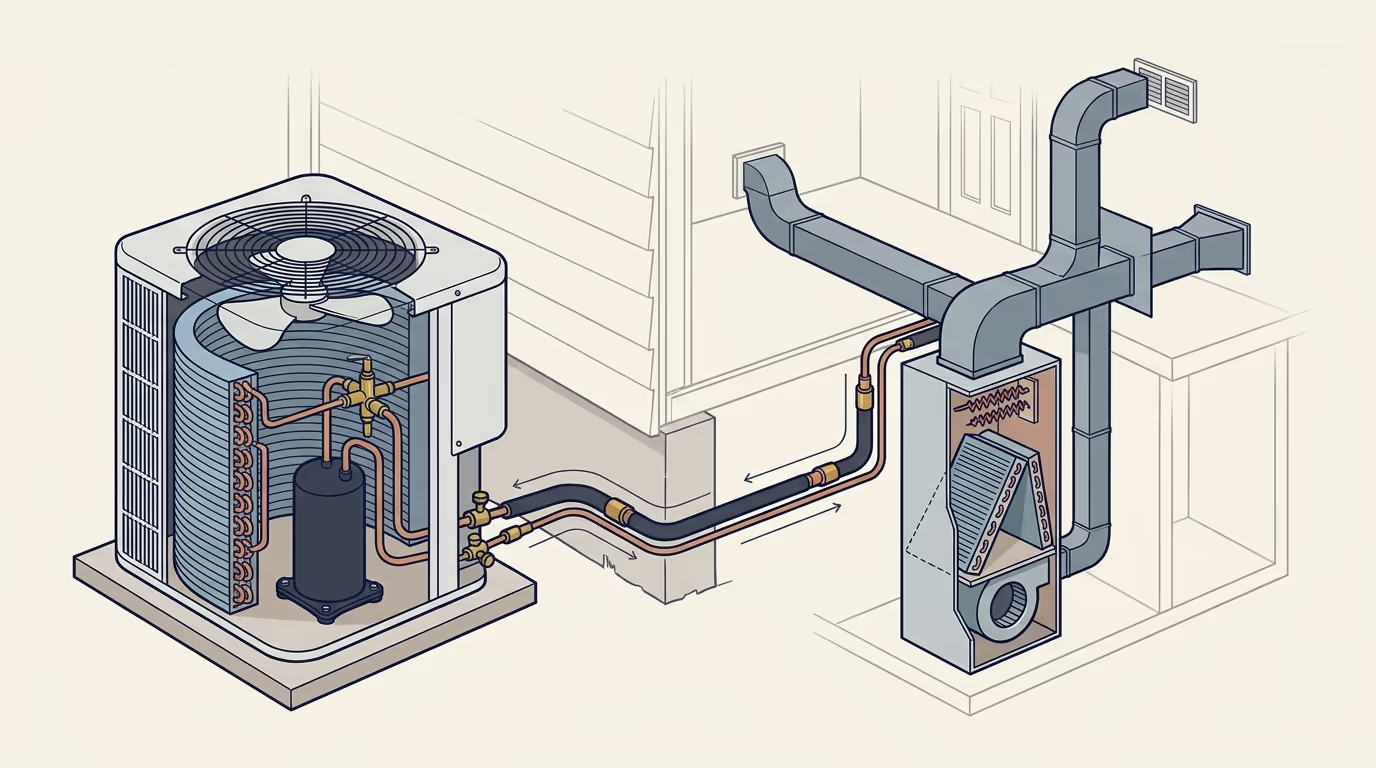
Part 1: Reversing valve
Switches the direction the refrigerant flows, so the same equipment cools in summer and heats in winter.
Part 2: Outdoor coil, fan and compressor
In heating mode the outdoor coil pulls heat from the outside air, and the compressor raises its temperature before it is sent indoors.
Part 3: Indoor air handler and coil
The blower moves house air across the indoor coil. The indoor and outdoor units are normally replaced as a matched pair.
Part 4: Electric heat strips
Backup heat for the coldest days and defrost cycles. Ask whether the new system includes them and whether your electrical panel can carry them.
Code and safety: Recovering, opening or recharging a refrigerant circuit must be done by an EPA Section 608 certified technician. Most jurisdictions require a mechanical permit to replace equipment; ask who pulls it and whether it is in the quote.
Market
Input Price Changes: Last 12 Months
Contractor quotes move with the cost of materials, equipment, and labor. The chart shows how official U.S. Bureau of Labor Statistics (BLS) price and wage series changed between Aug 25 and Aug 26. These are national input indices, not the price of this project, and they are not a forecast.
| BLS series | Aug 25 | Aug 26 | 12-month change |
|---|---|---|---|
| Air-conditioning, refrigeration, and forced air heating equipment manufacturing (PPI) (opens in a new tab) | 312.596 | 324.82 | +3.9% |
| Average hourly earnings, specialty trade contractors (production and nonsupervisory) (opens in a new tab) | 37.02 | 38.94 | +5.2% |
Source: U.S. Bureau of Labor Statistics, Producer Price Index and Current Employment Statistics, retrieved 2026-10-08. Recent months are preliminary and can be revised for up to four months. Price indices are not seasonally adjusted. Each line is the percentage change from Aug 25.
Payback
Energy Savings & Replacement Payback
Compare the operating cost of an older, less efficient unit with a more efficient replacement, and how long the difference takes to pay back.
Modeling assumption: set it for your climate.
Enter both ratings in the same system (labels since 2023 show SEER2; an older label may show only SEER). The model divides cooling load by each rating.
Modeling assumption.
From the unit label (example value).
From the quote (example value).
Starts at the heat pump guide average.
Starts at the AC compressor guide average.
EIA 2025 U.S. residential average: 17.23¢ per kWh.
EIA 2025 U.S. residential price, about $1.48 per therm.
From your utility or tax filing.
About $57 a month.
- Payback on the extra cost
- 10 years
- 10-year net result
- −$6
- Replacement
- $8,350
- Net out of pocket
- $8,350
- Repair instead
- $1,550
- Extra cost to recover
- $6,800
- 10-year utility savings
- $6,794
- 10-year return on the extra cost
- +0%
- CO₂ avoided a year (approx.)
- 3,025 lb
Defaults you can change: electricity 17.23¢ per kWh (EIA, U.S. residential average for 2025) and natural gas about $1.48 per therm (EIA's 2025 residential $15.34 per thousand cubic feet at 1,037 Btu per cubic foot; our conversion).
Cooling kWh = tons × 12,000 Btu × cooling hours ÷ (rating × 1,000); heat pump heating uses the same formula with heating hours and HSPF2. Hours and ratings are modeling assumptions you can change.
CO₂ uses 0.767 lb per kWh (EPA eGRID, 2023 U.S. average) and 11.67 lb per therm (EIA). Savings are not guaranteed; your bills, rates and use decide the result.
Quote check
Is Your Quote in the Typical Range?
Enter a written estimate to see where it falls against this guide's planning range for your labor market.
Within the typical range
Your quote: $8,350
$5,000 – $15,000
Average $8,350
Within the typical range. Quotes inside this range still differ with equipment, scope, access and warranty; compare itemized quotes line by line.
Getting comparable quotes
- Ask each contractor to price materials, labor, permits, disposal and optional work separately.
- Confirm the scope, equipment model, warranty, schedule and exclusions in writing.
- Compare like-for-like proposals from licensed, insured local contractors. Repair Cost Atlas does not match homeowners with contractors.
Direct answers
Frequently Asked Questions: Heat Pump Replacement Cost
Short, plain answers to the questions homeowners ask before contacting a contractor.
Most air-source heat pump replacements cost $5,000 to $15,000 installed, with a national average of about $8,350 (Fixr). This Old House reports a similar $8,042 average for a central heat pump, $8,007 for a whole-home air-source replacement and about $12,000 for a 2,000 sq ft home. Size and efficiency move the price most, so a large home or a 20+ SEER2 system can reach $25,000 (Fixr).
Fixr lists $5,000 to $8,000 for a 1,000 sq ft home (2 tons), $6,700 to $14,000 for 1,500 sq ft, $8,000 to $20,000 for 2,000 sq ft (3 to 4 tons), $9,500 to $22,000 for 2,500 sq ft and $15,000 to $25,000 for 3,000 sq ft.
The sources price them together: Fixr's and This Old House's figures cover installing a heat pump whether it replaces an old one or a furnace and AC. A first-time install can cost more when it needs ductwork ($1,400 to $6,000 per Fixr) or electrical work, which a like-for-like replacement usually does not.
Fixr reports a $400 average heat pump repair ($150 to $650) against an $8,350 average replacement. It suggests repairing systems under 10 years old with a minor problem, and replacing when the system nears the end of its 10 to 15 year life, when a major component fails, or under the 50% and $5,000 rules. This Old House reports that about 68% of surveyed owners repaired and 32% replaced, and suggests replacement near about 15 years.
Fixr lists heat pump compressor replacement at $800 to $2,500, a reversing valve at $350 to $700, a condenser at $1,000 to $4,000 and an air handler at $1,500 to $3,500. On an older system, compare those with a full replacement.
Most new split heat pumps now use R-454B or R-32. Under EPA's Technology Transitions rule, new residential and light commercial air conditioning and heat pump systems are limited to refrigerants with a global warming potential of 700 or less from January 1, 2025, and production of R-410A systems ended after December 31, 2024; manufacturers moved to R-454B and R-32, both classed as mildly flammable (A2L) refrigerants (ACHR News). In 2026 EPA removed the installation deadline for systems whose components were all made or imported before January 1, 2025, so some installers may still offer leftover R-410A equipment. Fixr lists R-454B at $60 to $100 per pound and R-410A at $50 to $80 per pound for later service.
Yes. EPA says the Technology Transitions rule does not restrict the continued use of existing systems: they may be serviced and repaired throughout their useful life, including replacing components. For R-22 systems, U.S. production of new R-22 has ended and only recycled, reclaimed or previously produced R-22 can be used for service, so repairs that need refrigerant get expensive (Fixr: R-22 can exceed $150 per pound). EPA does not require you to replace an R-22 system, and other refrigerants will not work well in it without changes to system components.
Fixr lists ongoing performance problems, frequent repair calls, unexpected jumps in electric bills, uncomfortable indoor temperatures and an older refrigerant. This Old House adds age (local installers put the lifespan at about 15 years), frequent costly repairs, and an addition or expansion that the old system cannot handle. Fixr says heat pumps typically last 10 to 15 years.
Usually. Fixr says most municipalities require permits for any mechanical replacement and lists permits and inspections at $50 to $300. In This Old House's survey, about 11% of owners who replaced a heat pump reported permitting delays, so ask the contractor to pull the permit and include it in the quote.
If the old system still runs, Fixr suggests scheduling installation in fall or spring, when lower demand can sometimes lower labor costs. Waiting until a mid-winter or mid-summer breakdown leaves less room to compare quotes.
Not consistently. Fixr lists air-source heat pumps at $4,000 to $11,000 against $5,000 to $12,000 for central AC on its AC installation page, and This Old House lists heat pump equipment at $4,200 to $7,600 against $4,000 to $8,000 for an air conditioner. A heat pump also replaces the furnace for most of the year, so compare it with the AC and furnace together.
Yes, if you choose a model rated for it. ENERGY STAR has a cold-climate designation for heat pumps that keep heating at low outdoor temperatures. Ask for the model's heating capacity at 5°F and its HSPF2 rating, and how the system will heat on the coldest days (Fixr notes heat pumps may need backup heat in very cold climates). Our sources do not price cold-climate models separately; This Old House says they typically cost more than standard models.
Fixr lists ductless mini-split heat pumps at $2,000 to $8,000 and geothermal at $15,000 to $35,000. This Old House lists a single-zone mini split at about $3,250 and a geothermal heat pump at about $17,000 for a small to medium home, or $30,000 or more for a large home.
Included: the outdoor unit, a matched indoor air handler or coil, refrigerant lines and charge, connection to existing ducts and wiring, removal of the old unit (included in labor per Fixr) and start-up. Often extra: ductwork changes, electrical service upgrades, a new thermostat and permits ($50 to $300 per Fixr). Ask which refrigerant the new system uses and how long the parts and labor warranties run; Fixr notes that paying a bit more for a longer warranty can save on future repairs.
Be cautious when the quote has no load calculation, no SEER2 and HSPF2 ratings or model numbers, no mention of how the system will heat on the coldest days in your area, or when a young system with one failed part (for example a $350 to $700 reversing valve) is quoted for full replacement.
Evidence
What supports these figures?
Each figure on this page and the published sources it is credited to. “Use with caution” marks figures we could not match to a published price. Wage, equipment and code references support only that narrower point, not an installed price.
| Estimate | Range or value | Published sources | Status |
|---|---|---|---|
| Fixr: heat pump installation averages $8,350, with an average range of $5,000 to $15,000. | $5,000 – $15,000 | Fixr (opens in a new tab) | Source reviewed |
| This Old House: $8,042 average installed cost for a central heat pump; $8,007 for a whole-home air-source replacement. | $8,042 | This Old House (opens in a new tab) | Source reviewed |
| Fixr: heat pump repair averages $400 ($150 to $650); compressor replacement $800 to $2,500. | $400 repair | Fixr (opens in a new tab) | Source reviewed |
| EPA: new residential and light commercial AC and heat pump systems limited to GWP 700 from January 1, 2025; no installation deadline for systems whose components were all made or imported before January 1, 2025; existing systems may be serviced and repaired, including replacing components. | GWP 700 / Jan 1, 2025 | U.S. Environmental Protection Agency (opens in a new tab) | Source reviewed |
Sources
Methodology & Data Sources
The typical range and average come from the cost publishers listed below; we compare what they publish and label figures we calculate ourselves. Bureau of Labor Statistics (BLS) wage data adjusts only the labor share when you set a ZIP code or state. Technical references support specifications, not prices.
Cost publishers · 2 independent (9 pages)
- 1.
- 2.
- 3.
- 4.
- 5.
- 6.Fixr: Cost to Repair Ductwork (opens in a new tab)Read Nov 9, 2026
- 7.Fixr: Furnace Replacement Cost 2026 (opens in a new tab)Read Nov 9, 2026
- 8.
- 9.
Wage data and technical references
- 10.
- 11.
- 12.
- 13.
- 14.
- 15.
- 16.
What changed
- Added what changed with refrigerants (R-454B and R-32 in new systems since 2025, servicing existing R-410A and R-22 systems), from EPA and ACHR News. Cold-climate models are no longer tied to SEER2 price bands without a source. HomeGuide's range was dropped because the page could not be re-checked. Added answers on signs, permits and the best time to replace.